Journal · Design
A note on what’s actually changing in private gym design this year, and what isn’t.
Most of what gets called a “trend” in home-gym design isn’t a trend. It’s a colourway. Sage green walls, terrazzo floors, brushed brass dumbbells. None of it changes how the room trains, how it lasts, or what it costs to run.
The shifts that actually matter this year are quieter, and they’re structural. Three of them are worth a paragraph each.
The recovery room has moved next door.
Five years ago, “home gym” meant a room of free weights and a mirror. Now, more than half of the briefs we take on include a recovery suite — sauna, ice bath, sometimes red-light. The boundary between training and recovery has dissolved, and the room layouts follow. We design wet and dry zones together, with passive ventilation between them, instead of treating recovery as a separate plumbing project bolted on at the end.
Wood is replacing rubber.
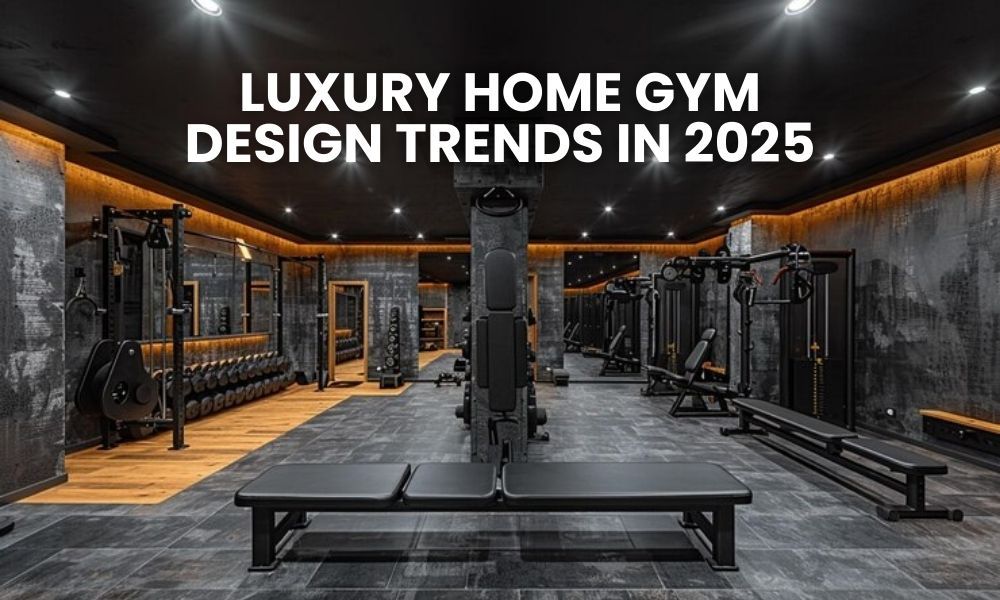
Rubber-tile flooring is the default, and it shouldn’t be. It off-gasses, it dates within a decade, and it has no second life. The high-end brief is moving toward solid wood with a sport finish, occasionally over a layer of cork for shock-absorption — beautiful, durable, repairable, and (this matters now) carbon-positive over its life-cycle. Ten years ago this was a bespoke ask. Today it’s the starting point.
The room is sized to the programme, not the other way around.
We used to lay out a room and then pick equipment that fitted. The better way around is to ask what the client trains, then design the space backwards from that. A 25 m² room programmed for a strength-and-conditioning routine plays bigger than a 50 m² room filled with cardio machines no one uses. Programme-led design takes longer at the briefing stage. It saves a third of the floorplan, and it’s the difference between a gym that gets used and one that becomes a storeroom.
Sound, light, and air.
The three things clients used to forget about now arrive first in the brief.
Sound, because a private gym at the end of the kitchen is no longer a sealed basement room. Footwork through a 5am session has to land in the dropped slab, not the bedroom directly above. Acoustic floors and ceiling-decoupled lighting do most of the work. The rest is room geometry — break a long wall, kill the slap echo, and the room sounds like a studio instead of a corridor.
Light is harder. The trend we’ve watched arrive over the last eighteen months is daylight-first. South-facing rooms with a deep reveal, north-facing rooms with a lightwell, and in basement builds, full-spectrum LED that shifts colour temperature through the day. Cooler at 6am, warmer at 8pm. It sounds excessive on paper; in the room, it changes how often the room gets used.
Air sits underneath both. Most home gyms are still built with domestic-grade HVAC and a tower fan in the corner, which is fine for a Peloton and brutal for a barbell session. We’re now specifying a six-to-ten air-changes-per-hour fresh-air feed as standard, separate from the rest of the house’s mechanical system. The brief gets thicker, the M&E sub-bill goes up, and the room becomes usable in July. Sauna and ice-bath rooms in particular can’t share air with the gym — the humidity is incompatible. We design those as separate volumes from the start.
None of this shows up in a glossy interior photograph. It shows up in whether the room gets trained in seven days a week or three.
A note on equipment longevity.
One last shift worth naming. The client conversation has moved from “what’s the latest” to “what’s still here in ten years.” A rack with welded steel and a wood facia outlasts a powder-coated assembly bought online. A platform built from oak with replaceable rubber strips outlasts a bonded composite tile. Equipment that can be re-shod, re-stained and re-cushioned outlasts equipment designed to be replaced.
That changes the design conversation. It moves us closer to architecture — where you specify materials for a fifty-year horizon, not a five-year one — and further from retail. It also explains why our workshop is the shape it is. Most of what we build is a one-off. Most of what we install is a one-off. The trend isn’t bespoke for its own sake; it’s bespoke as a durability strategy.
If any of this maps onto a brief you’re scoping — a single-room conversion, a recovery suite, or a full estate-grade build — it’s the kind of work our design-and-build studio takes on most weeks. The shape of the room dictates the kit, not the other way round.
None of these are trends, exactly. They’re course-corrections. They make rooms that train better, last longer, and cost less to run. That’s the only kind of change in this industry worth tracking.
Leave a Reply