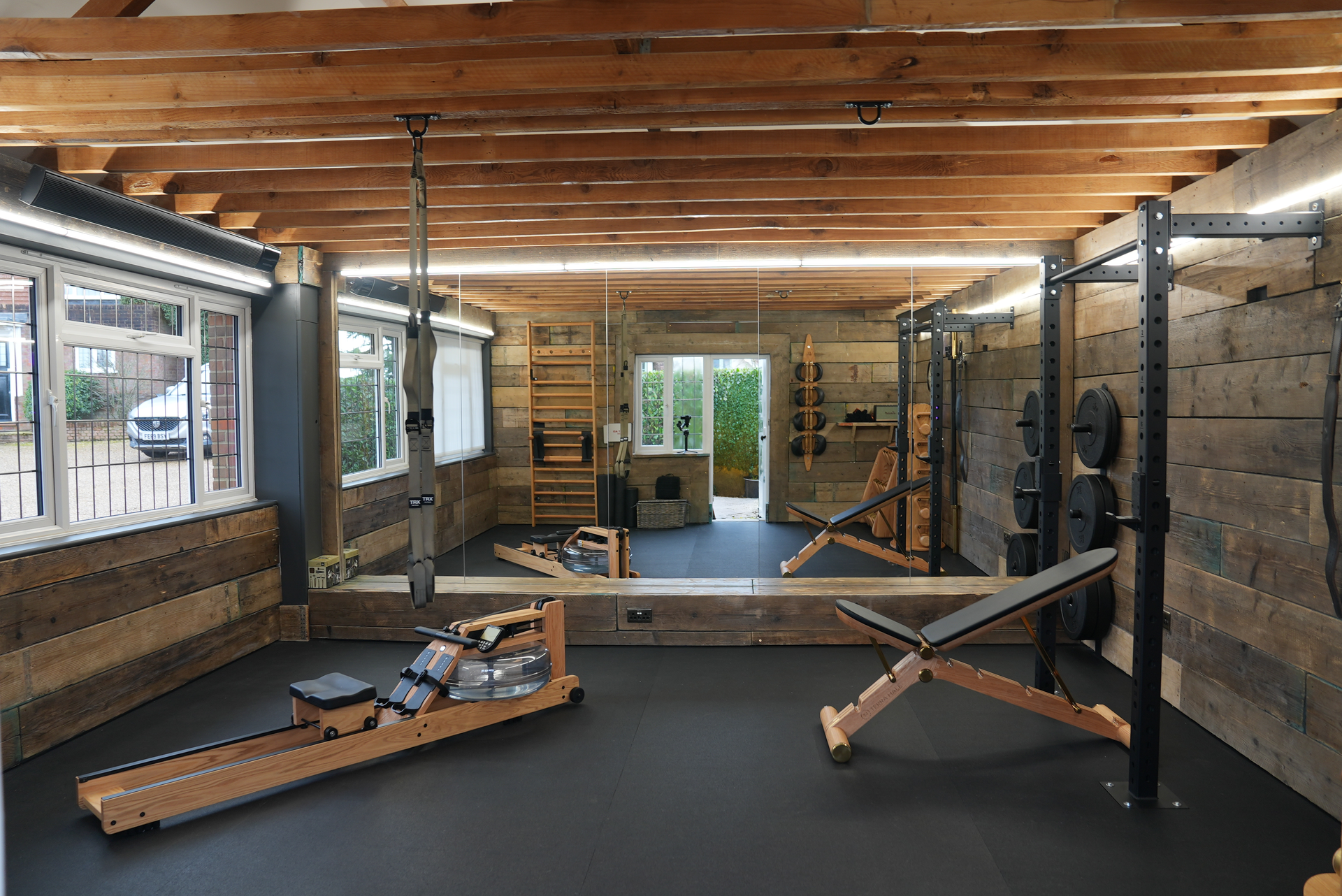
The honest answer is “it depends on the room”, and the useful answer is a set of numbers. We have designed and built private gyms for ten years, in London, New York and Dubai, and the projects fall into three bands often enough that we price them that way. Here is what each band buys, what pushes a project up or down inside it, and where the money is well spent.
The three bands
Compact — from £25,000. A spare room, a dressing room, a corner of an apartment; up to about 15 m². Space assessment and layout plan, floor, wall, mirror and lighting, and a curated equipment package chosen for the programme rather than the catalogue. This is the tier most people underestimate: a well-planned 12 m² room trains better than a badly planned 40 m² one.
Signature — from £75,000. A dedicated room, a garden studio or a basement conversion; 15 to 40 m². Architectural design and engineering, a bespoke wooden free-weight wall built in our workshop, and one piece of recovery — a sauna or an ice bath. This is our most common commission.
Estate — from £200,000. Country houses, estates and multi-room facilities; 40 m² and up. A full architectural team, a custom wooden equipment range, and a complete recovery suite with hot and cold. At this scale the gym is usually one part of a wellness wing, and the design work runs alongside the house architect.
What moves the number up
- Groundworks. Basements are the most rewarding rooms and the most expensive to prepare: waterproofing, head-height, drainage for a plunge, and getting materials down the stairs.
- Recovery. A combined sauna, a steam room and an ice bath each bring their own mechanical, electrical and ventilation work. Design them in from the start and they cost a fraction of what they cost to add later.
- Bespoke equipment. Hand-turned walnut dumbbells cost more than chromed steel. They also last a lifetime and can be re-oiled rather than replaced, which is why our builds carry roughly one-fifth the carbon of a commercial fit-out.
- Acoustics. A gym above a bedroom or beside a study needs a decoupled floor and a considered ceiling. Skipping it is the most common regret we hear from people who built with someone else.
- Integration. Lighting scenes, sound, climate and the recovery suite on one simple control. Worth it if you will use it; not worth it as a feature.
What costs less than people think
Mirror walls, good lighting and proper ventilation are the three things that make a room feel expensive, and none of them is. A mirror wall is measured joinery; lighting is a design decision, not a budget line; ventilation is a fan sized correctly in the first drawing. The cheap-looking rooms are the ones that skipped these and spent the money on machines.
What to watch for in a quotation
Ask who is building the equipment, who is installing it, and whether they are the same company. Ask what floor depth is specified for dropped weights, what ventilation rate for cardio, and how the sauna and plunge are drained. Ask for a single delivery date. The quotations that cannot answer those questions are the ones that grow.
Where to start
A complimentary design consultation — sixty minutes, on site or by video — is where every one of our projects begins. We measure, we ask how you train, and we come back with a scope and a number. If you want to see the pieces first, the equipment range is a good place to look, and our London, New York and Dubai pages cover how we work in each city. Tell us about your space and we will be in touch within one working day.