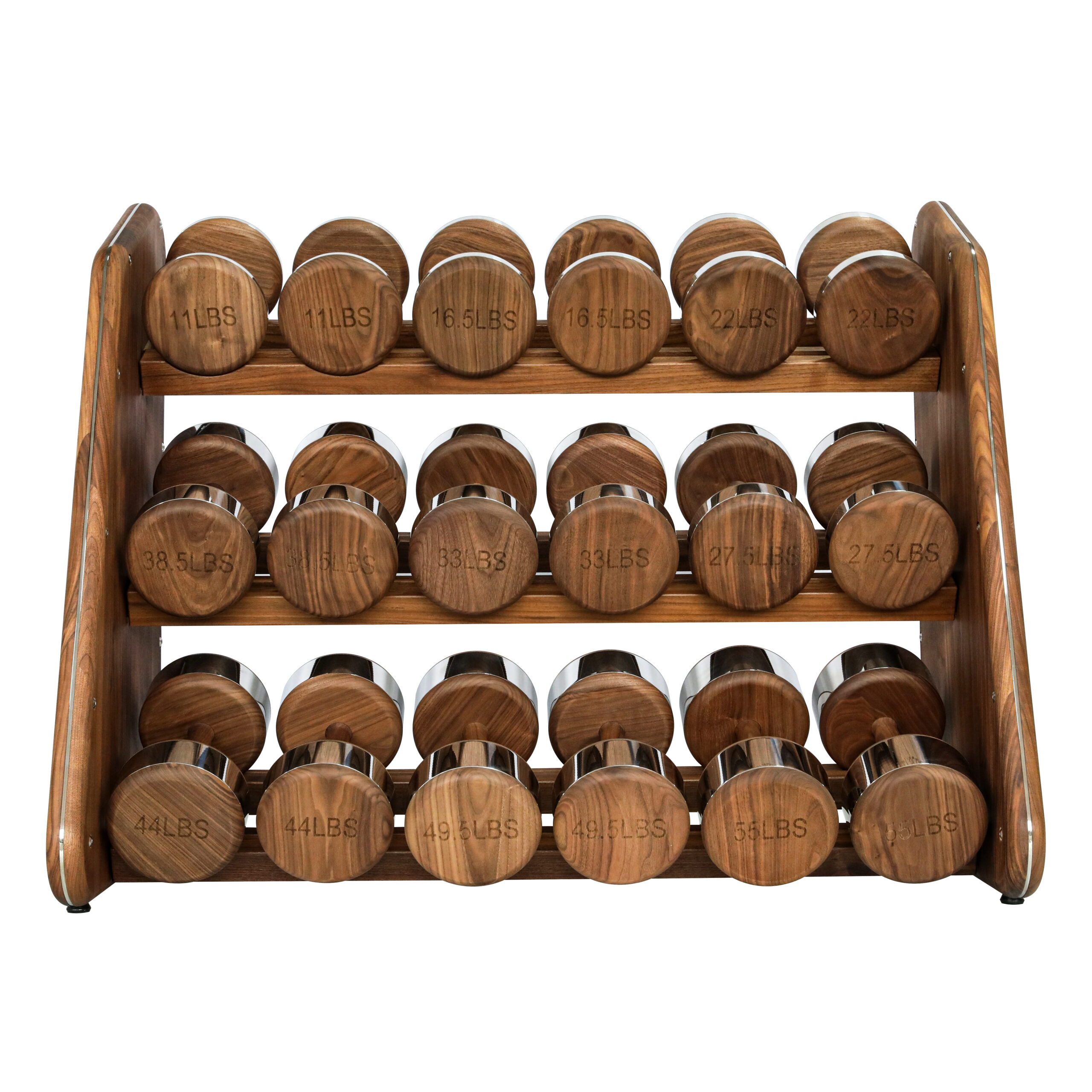
Commercial gyms look like car parks because they are furnished like car parks: welded steel, rubber cladding, chrome. It is the right answer for a floor of two hundred members. It is the wrong answer for a room in a house. Here is what changes when the equipment is made of wood, and what does not.
Sound
Steel and rubber amplify. Wood absorbs. A dumbbell set down on a walnut stand makes a soft knock; the same weight on a steel rack rings through the slab. In a family home, where the gym is at the end of the kitchen or above a bedroom, this is the difference between training at six in the morning and not. Our water rower and self-powered treadmill are chosen for the same reason: no motor, no fan.
Aesthetics — and use
A gym that looks like a room you would live in gets used. That is not a design opinion; it is what we see in aftercare visits. Rooms with a walnut dumbbell stand and an ash bench stay in use for years; rooms furnished from a commercial catalogue become storerooms. Wood is warm in the hand and warm in the room, and it ages — it does not date.
The engineering question
Is wooden equipment as strong as steel? For the training most people do at home — dumbbells, kettlebells, benches, rowing, running, bodyweight — yes, comfortably. Our pieces are solid hardwood, through-jointed, with brass, steel or copper wherever load is carried or something pivots, and every piece is load-tested before it leaves the workshop. For heavy compound lifting, the squat rack puts steel where the bar lands and timber everywhere the eye does. Wood is the finish and the structure; metal is used where metal is right.
Longevity
Rubber perishes, chrome pits, and welded steel ends up in a skip within a decade. Solid wood can be sanded and re-oiled; a brass hinge can be replaced without replacing the bench. Every piece we make is built to be repaired, which is the quiet reason a Home Gyms Design build carries roughly one-fifth the carbon of an equivalent commercial fit-out. It is not a story we tell. It is the way the workshop runs.
Sustainability, honestly
Timber is a renewable material and a carbon store; rubber and steel are neither. But the bigger sustainability win is simpler: equipment that lasts thirty years and never needs replacing. Buying once, well, beats buying anything green twice.
What is in the range
Free weights hand-turned in our London workshop — dumbbell stands, kettlebell towers, plate trees, benches — a nine-piece Training Collection of cardio and strength in pine and steel or walnut and copper, and a recovery suite of sauna, steam room, ice bath and lounger. Every piece can be commissioned on its own or as part of a room. The full range is here; a consultation is where a piece becomes yours.